ADVANCED READING: Aquarium Cycling; A Geneticist’s Guide to the Aquarium Microbiome

A Systems Biology Approach to the Mature Aquarium
For decades the aquarium hobby has described biological filtration with a simple equation: Ammonia → Nitrite → Nitrate. Though this is a simple and somewhat valid explanation; this is a very incomplete version of events in a truly established aquarium.
Modern microbial ecology shows that biological filtration is not a simple linear pathway. What newer aquarists call “cycling” is merely the first stage of ecological succession. Instead, a mature aquarium is a self-organizing microbial ecosystem composed of hundreds to thousands of interacting species, meaning that the concentration or amount of each species present will fluctuate based on the conditions (pH, concentration of ions, minerals and available food) within the aquarium. Additionally, even if you seed your aquarium with the filter “gunk” of another aquarist; the concentrations of the microbes in your aquarium might settle to different amounts to adapt to the base conditions of your own aquarium.
A truly stable aquarium emerges only when microbial communities assemble into a metabolically interconnected network with stable concentrations; one capable of recycling nutrients, resisting pathogens, and supporting the health of its inhabitants.
In ecological terms, the aquarium transitions from an unbalanced microbial landscape into a climax community: a stable, resilient ecosystem maintained by complex biological interactions which can persist until a major disturbance occurs (Mallon et al., 2015).
Understanding this transition changes how we approach aquarium management.
Rather than chasing chemical numbers alone, we begin cultivating microbial ecology.
1. Ecological Succession: The Real Meaning of “Cycling”
When an aquarium is first assembled, every surface (glass, substrate, filter media, plants) is essentially uninhabited. While there might be some microorganisms, they are scattered, scarce and “not in the right place” (either not aquatic thriving species or simply not in the right part of the aquarium for them to thrive). There is additionally a lack of community which provides security in form of biofilms which we will touch on a bit later.
Microorganisms quickly start to colonize these surfaces through a process called microbial succession, similar to how forests regrow after disturbance.
Stage 1: Opportunistic Colonizers
Within hours to days, fast-growing heterotrophic (feeding on various compounds) bacteria (mostly) dominate but slower growing Archaea and Fungi (yeasts and moulds) are introduced.
Common bacterial genera include:
Pseudomonas
Aeromonas
Flavobacterium
These organisms rapidly metabolize dissolved organic carbon (DOC) from food, plant matter, and microbial debris. They thrive in systems where food is abundant and your newly established aquarium has this abundance. This is where biological compounds decompose. It is important to note that “rotting” is specifically caused by these microorganisms and, in a completely sterile environment, food will not rot.
These organisms reproduce quickly but inefficiently. In ecological terms, they are r-strategists.
At this stage, the system is unstable and prone to ammonia spikes.
Stage 2: Nitrifying Microbes
As ammonia accumulates, specialized bacteria capable of oxidizing nitrogen compounds colonize surfaces.
Two major groups traditionally perform this process when ammonia is abundant:
Ammonia oxidizers:
Nitrosomonas
Nitrosospira
Nitrite oxidizers:
Nitrospira
Nitrobacter
These organisms perform chemolithoautotrophic metabolism (an organism that uses inorganic chemical compounds to source its energy and electrons, and use carbon dioxide as a carbon source).
However, nitrifiers grow extremely slowly.
Ammonia oxidizers
Doubling Time 10–30 hours
Nitrite oxidizers
Doubling Time 20–40 hours
This slow growth explains why cycling takes weeks rather than days when done “from scratch”. It is important to mention that the concentration of bacteria initially increases explosively (bacterial bloom) but then also decreases rapidly once food has been consumed. Archaea and fungi start their colonization at the same time; but their growth is slow. Their highest concentration appears later but then stabilizes at a more consistent baseline.
Stage 3: Ecological Maturation
Over time the microbial community diversifies.
New functional guilds emerge:
archaea
denitrifying bacteria
fermenters
protozoa
micro-crustaceans
bacteriophages
This increasing diversity leads to functional redundancy. Multiple species will be performing the same metabolic roles at different rates and they adjust their concentrations to the conditions within your aquarium.
At this point, the aquarium transitions from chemically filtered to ecologically regulated and this is what we truly want.

2. The Archaeal Revolution in Nitrification
One of the most important discoveries in microbiology over the past twenty years is that nitrification is often dominated not by bacteria, but by archaea. Archaea represent one of the three domains of life: Bacteria, Archaea, and Eukarya. While archaeal cells resemble bacteria in that they lack a nucleus, their molecular biology is fundamentally distinct, and modern genomic research suggests that eukaryotes may have evolved from archaeal ancestors.
These organisms belong to the phylum Thaumarchaeota.
Common ammonia-oxidizing archaea include:
Nitrosopumilus
Nitrososphaera
These microbes thrive in extremely low-nutrient environments.
Why Archaea Matter
Research by Martens-Habbena et al. (2009) demonstrated that archaeal ammonia oxidizers have an extraordinary affinity for ammonia.
Nitrosopumilus maritimus
Km ≈ 133 nanomolar
Typical bacterial nitrifiers:
10–1000 micromolar
This means archaeal nitrifiers can operate efficiently at thousands of times lower ammonia concentrations Some ammonia-oxidizing archaea can supplement their metabolism with organic compounds, but ammonia oxidation remains their primary energy source. Hence, they stay alive hidden in the aquarium and explode in numbers when conditions are right (ammonia levels increase). Many bacterial specialists in ammonia oxidation will starve at those lower concentrations.
Think of bacterial nitrifiers as bulldozers. They are excellent at clearing large ammonia spikes but starve when the concentration drops.
Archaea behave more like precision instruments, maintaining extremely low ammonia levels. They remain present even after the bacteria have starved and react to your ammonia levels by increasing their metabolism and proliferating.
In mature aquaria, especially low-bioload shrimp tanks, AOA likely dominate nitrification. They help maintain near-undetectable ammonia concentrations.
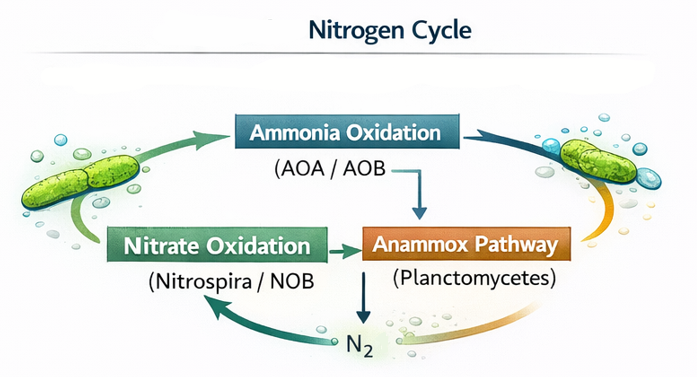
3. Comammox: The Single-Cell Nitrogen Reactor
For more than a century nitrification was believed to require two organisms.
Step 1: Ammonia oxidizers
Ammonia → Nitrite
Step 2: Nitrite oxidizers
Nitrite → Nitrate
In 2015 this paradigm changed.
Researchers discovered Comammox (Complete Ammonia Oxidation) bacteria in the genus Nitrospira (Daims et al., 2015). It is important to note that, even though this has not yet been isolated, it is highly likely that certain species of archaea and fungi posses the same biological engine. This means that nitrite would never occur free in the water.
These organisms perform both steps within a single cell.
They contain genes for enzymes (proteins that increase rate of reactions):
Ammonia monooxygenase (AMO)
Hydroxylamine oxidoreductase (HAO)
Nitrite oxidoreductase (NXR)
Why This Matters
Comammox bacteria and the above-mentioned archaea and fungi, grow slowly but efficiently and dominate low-nutrient, stable systems. Instead of a two-step relay race between ammonia oxidising and nitrite oxidising organisms, nitrification becomes a single metabolic pathway.
This reduces the risk of nitrite accumulation and increases ecosystem stability.
4. Biofilms:

Almost all microbial life in aquariums exists within biofilms. A biofilm is a structured microbial community embedded in a matrix of extracellular polymers. Think of it as a city hosting many different species of archaea, bacteria and fungi. They all interact with each other within this city and complete different jobs to make the community grow and thrive. Oxygen concentration declines rapidly with depth inside biofilms. While the outer surface may be fully aerobic (oxygen abundant), deeper layers can become hotspots for microaerophilic microbes (favouring low oxygen environments) or even anaerobic (without oxygen), allowing multiple metabolic pathways to operate simultaneously.
Many microbes in biofilms exist in syntrophic relationships, where the metabolic byproducts of one organism serve as the energy source for another.
Every aquarium has a microbial carrying capacity determined largely by surface area. Biofilms grow on solid surfaces rather than in the water column, meaning that tanks with more substrate, plants, and porous filter media can support far larger microbial populations.
This matrix contains:
Polysaccharides (sugars)
proteins
lipids (fats, oils, waxes and steroids)
extracellular DNA (outside of a cell)
(Flemming & Wingender, 2010)
Biofilms attach to virtually every surface:
filter media
plants
rocks
substrate
glass
plastic
You can feel these biofilms on almost every surface of the aquarium. When lightly touching the glass, rocks or even the leaves of plants; you can feel a soft slimy substance on it. Smooth plastics support biofilm growth but generally provide less surface complexity than porous natural materials. Natural materials such as stone, wood, and soil provide microscopic pores and irregularities that allow biofilms to anchor and develop complex three-dimensional structures. Smooth plastics, while common in aquariums, often provide less effective colonization surfaces.
Unlike fish or shrimp populations, which are limited primarily by food availability, microbial populations in aquatic systems are usually limited by surface area. Most microbes in aquariums do not live freely in the water column. Instead, they attach to solid surfaces where they form structured biofilms.
These surfaces include:
• substrate particles
• plant leaves and stems
• rocks and driftwood
• filter media
• glass walls
• decaying organic matter
Because biofilms grow on surfaces rather than in open water, the total amount of microbial life an aquarium can support depends largely on how much surface area exists for colonization.
A tank with only smooth glass, plastic decorations, and minimal substrate provides relatively little microbial habitat. In contrast, aquariums containing soil, porous rock, plant roots, and dense vegetation offer enormous microscopic surface area. Even materials that appear smooth to the human eye can contain thousands of microscopic crevices where microbes can attach and grow.
Porous materials are particularly important. Natural substrates, pumice, lava rock, and sponge filters contain intricate internal pore networks that dramatically increase available microbial habitat. These structures allow biofilms to grow not only on the outside surfaces but also deep within the material itself.
As microbial carrying capacity increases, the aquarium gains several ecological advantages:
• Faster nutrient processing
• Greater resilience to ammonia spikes
• More stable nitrogen cycling
• Higher microbial diversity
• Improved resistance to pathogenic microbes
In effect, increasing microbial habitat increases the biological buffering capacity of the aquarium. Disturbances such as overfeeding, decaying plant matter, or temporary ammonia spikes can be absorbed by the larger microbial community before they impact fish or shrimp.
This concept helps explain why natural aquariums with abundant plants, soil substrates, and porous materials often become far more stable over time than sparsely decorated systems. By increasing available surface area, these aquariums allow a much larger and more diverse microbial ecosystem to develop.
From an ecological perspective, a successful aquarium is therefore not just a container of water—it is a three-dimensional habitat for microbial life.
The more habitat that exists, the more stable the ecosystem becomes.
5. Microbial gene and information exchange:
Biofilms are also hubs of genetic exchange. There are mechanisms that allow for microbes to absorb genetic information from other species if they find it in the environment or it is brought to them. This is called lateral gene transfer. Though this happens rarely and, even when it does happen, many transferred genes are non-functional or poorly expressed in their new host, but occasionally they provide useful traits that natural selection can retain. Namely, DNA structure is universal but the code can be read in multiple ways. Same as how multiple languages use the same letters but pronounce them differently. Same words can also mean different things in different languages. The protein produced, therefore, could be completely non-functional. But, we do see this happened many times in the past for many different organisms by examining their DNA, the DNA of close and distant relatives of that species and comparing databases.
Microbes can share genes via:
Conjugation (Direct, cell-to-cell transfer of DNA)
Transformation (Uptake of free "naked" DNA from the surrounding environment)
viral transduction (Transfer of bacterial DNA from one cell to another using a virus)
Collectively these processes form the mobilome.
Research suggests gene transfer occurs far more frequently in biofilms than in free-floating cells (McDaniel et al., 2010).
Quorum Sensing: The Molecular Switch for Collective Behavior
In a mature aquarium, microbial behavior changes based on population density. This process is called Quorum Sensing (QS). It allows individual bacteria to "sense" how many other microbes are nearby and adjust their metabolic activity accordingly.
The Feedback Loop
Bacteria release small signaling molecules called Autoinducers into the surrounding water.
At Low Density: These molecules drift away, and the bacteria continue to act as independent individuals.
At High Density: Within a stable biofilm, these molecules accumulate. When they reach a specific concentration, they bind to receptors that trigger a change in the microbes' DNA expression.
Functional Impacts on the Aquarium
This shift from individual to collective behavior provides three major benefits to an established system:
Coordinated Biofilm Construction: Biofilms are not just random piles of bacteria. Once a quorum is reached, the community synchronizes the production of Extracellular Polymeric Substances (EPS). This creates a highly structured environment with water channels that allow nutrients to reach the deepest layers of the filter media.
Resource Optimization: Quorum sensing allows different species to time their metabolic outputs. In an established tank, species $A$ will only release a specific byproduct when species $B$ (the consumer) has reached a high enough population to process it. This prevents the "leakage" of toxic intermediates like Nitrite or Hydrogen Sulfide.
Pathogen Defense (Quorum Quenching): Established microbial communities can actively "jam" the signals of invading pathogens. By releasing enzymes that break down the autoinducers of invaders like Vibrio, the resident microbes prevent the pathogens from coordinating a bloom or launching an infection.
Implication for Aquariums
Microbial communities in established tanks can adapt rapidly to environmental stress. Both by exchanging material as well as by communicating with one another.
6. The Nitrogen Web: Beyond Nitrification
The nitrogen cycle in aquariums involves multiple pathways beyond simple nitrification. Under low oxygen conditions, certain bacteria use nitrate as an electron acceptor. This process converts nitrate into nitrogen gas.
Common genera:
Paracoccus
Pseudomonas
Bacillus
Denitrification occurs in:
deep substrate layers
clogged filter media
porous rocks
(Zumft, 1997)
Anammox
In specialized anaerobic environments, bacteria perform anaerobic ammonium oxidation:
Ammonia + Nitrite → Nitrogen gas
(Strous et al., 1999)
While less common in aquaria than denitrification, this process can occur in deep biofilms and sediments.
7. Redox Stratification in Substrates
Substrates develop layered chemical environments similar to lake sediments. Oxygen typically penetrates only a few millimeters into fine sediments. Below this depth, microbial metabolism rapidly consumes available oxygen, creating microenvironments where anaerobic processes dominate.
Substrate Microzones

These gradients allow a complete nitrogen cycle to occur within millimeters of sediment. Within micrometers, oxygen concentration can change dramatically.
This allows multiple metabolic pathways to operate simultaneously within a single biofilm. However, excessively deep anaerobic zones may produce hydrogen sulfide, which can be toxic.
8. The Viral Shunt: Microbial Population Control
Aquatic ecosystems contain enormous numbers of viruses. Typical seawater contains approximately 106-108 (1 million to 100 million) and freshwater approximately 106 to 109 Viruses/mL. For freshwater this varies significantly based on stagnancy and nutrient availability. Rivers will contain less than a stagnant swamp. Many of these are bacteriophages or viruses that specifically target bacteria. When they infect bacteria, they cause cell lysis, releasing nutrients back into the environment. This process is known as the viral shunt (Wilhelm & Suttle, 1999).
The viral shunt:
prevents microbial monopolies (one species of bacteria can not overpopulate a mature aquarium as the bacteriophage that targets it explodes in numbers with it)
recycles nutrients
promotes biodiversity by allowing for niches to be filled by other microbes.
Even though aquarists rarely think about viruses, they are essential regulators of microbial ecosystems.
9. Microbial Grazers: The Invisible Clean-Up Crew
A mature aquarium contains not only microbes but also a wide variety of microscopic animals collectively known as microfauna. These organisms include:
• nematodes (detritus worms)
• oligochaete worms
• rotifers
• ciliates
• copepods
• ostracods
• tardigrades (occasionally)
Most of these organisms arrive unintentionally with plants, substrate, or water from other aquariums. Over time they establish small populations within biofilms, substrates, and plant surfaces.
Microfauna play a crucial ecological role in regulating microbial communities. Many species graze directly on bacteria, algae, and biofilm. By feeding on microbes they prevent biofilms from becoming excessively thick or oxygen-limited, keeping microbial metabolism active. This grazing pressure stimulates continual microbial growth, which in turn accelerates nutrient recycling.
Detritus worms are particularly important in aquarium sediments. These small oligochaete worms burrow through the substrate while feeding on organic detritus and microbial biomass. Their movement mixes sediments and improves oxygen penetration, a process known as bioturbation. In natural aquatic systems, bioturbation strongly influences nutrient cycling and microbial activity (Meysman et al., 2006).
In effect, microfauna act as ecosystem engineers within the aquarium. By grazing on microbes and disturbing sediments they maintain active microbial communities and help prevent the accumulation of excess organic waste.
For this reason, the presence of small populations of detritus worms or other microfauna is usually a sign of a healthy and mature aquarium ecosystem, rather than a problem.

10. Shrimp Tanks: The Holobiont Concept
Shrimp aquariums represent a particularly interesting case of ecosystem integration.
Shrimp cannot digest complex plant polymers such as:
cellulose
lignin
Instead, microbes break down plant material into simpler compounds. You can see this when you introduce plant leaves such as Indian almond leaves into the aquarium. They grow a layer of white biofilm. The shrimp themselves do not feast on the leaf itself but on the microbes that have grown by digesting the leaf itself.
This creates a holobiont system—a partnership between animal and microbial ecosystem (Holt et al., 2021).
Biofilm as Shrimp Nutrition
For species such as Neocaridina, biofilm provides:
microbial protein
fatty acids
vitamins
enzymes
When shrimp graze on biofilms they also ingest beneficial bacteria that colonize their gut microbiome.
Studies on shrimp microbiota show that these microbes contribute to:
immune function
pathogen resistance
digestion
(Rungrassamee et al., 2014)
11. Functional Redundancy: The Foundation of Stability
The defining feature of a mature ecosystem is functional redundancy.
Multiple organisms perform the same ecological roles:
ammonia oxidation, nitrite oxidation, nitrate reduction
organic matter decomposition
If one species declines, others compensate. This redundancy creates resilience by having niches filled with varying organisms that are adapting to stressors or pathogens that might enter your aquarium.
It is why established aquariums can withstand disturbances that would crash younger systems. Aquarists often notice that tanks older than six months behave very differently from newly established systems. This is because microbial diversity and functional redundancy increase dramatically with time, allowing the ecosystem to buffer disturbances more effectively. However, it is extremely important to state that chemical hazards that may enter your aquarium might not be digestible and that we should remain vigilant when we use soaps or other compounds that specifically target bacteria and viruses. Introducing such contaminants to your aquarium might disturb your microbes, flora and fauna beyond saving.
Cycled Tank vs Mature Ecosystem
Conclusion: Cultivating Complexity
A mature aquarium is not built by chemicals or bottled bacteria alone. It emerges through time, microbial succession, and ecological interactions. You will, if you are starting “from scratch”, inadvertently introduce various microbes to your aquarium over time; by introducing plants, rocks and other materials as well as with your hands and any tools that you might be using.
True stability arises when:
microbial diversity increases
metabolic pathways interconnect
food webs expand from microbes to microfauna
genetic exchange accelerates adaptation
At that point the aquarium becomes something remarkable: a miniature ecosystem capable of regulating itself.
And like any ecosystem, its greatest strength lies in complexity.
References
Daims, H. et al. (2015). Complete nitrification by Nitrospira bacteria. Nature.
Fenchel, T. (1986). The ecology of heterotrophic microflagellates. Advances in Microbial Ecology.
Flemming, H.C. & Wingender, J. (2010). The biofilm matrix. Nature Reviews Microbiology.
Holt, C. et al. (2021). The shrimp gut microbiome and host interactions. Frontiers in Marine Science.
Mallon, C.A. et al. (2015). The role of microbial diversity in ecosystem resistance. ISME Journal.
Martens-Habbena, W. et al. (2009). Ammonia oxidation kinetics determine niche separation of nitrifying archaea and bacteria. Nature.
McDaniel, L.D. et al. (2010). High frequency of horizontal gene transfer in microbial communities. Science.
Morris, B.E. et al. (2013). Microbial syntrophy: interaction for the common good. FEMS Microbiology Reviews.
Rungrassamee, W. et al. (2014). Characterization of intestinal bacteria in shrimp. PLoS One.
Strous, M. et al. (1999). Missing link in the nitrogen cycle: anaerobic ammonium oxidation. Nature.
Wilhelm, S.W. & Suttle, C.A. (1999). Viruses and nutrient cycles in aquatic ecosystems. BioScience.
Zumft, W. (1997). Cell biology and molecular basis of denitrification. Microbiology and Molecular Biology Reviews.
Waters, C. M., & Bassler, B. L. (2005). "Quorum sensing: cell-to-cell communication in bacteria." Annual Review of Cell and Developmental Biology.
Grandclément, C., et al. (2016). "From Quorum Sensing and Quorum Quenching to Microbial Ecology and Next-Generation Biocontrol." Marine Drugs.
Comments (0)
Want to leave a comment? Sign in to your account to join the discussion.
Don't have an account? Create one